John Dee and the Empire of Angels by Jason Louv

John Dee and the Empire of Angels: Enochian Magick and the Occult Roots of the Modern World
Jason Louv
Inner Traditions, 2018

wp36 john-dee-and-the-empire-of-angels-9781620555897_hr

Review by Barbara Ardinger.

Let’s begin with a spoiler. Although many Neopagans are interested in occultism and the work of the 16th-century astrologer John Dee, it’s important to keep in mind that Dee was nothing close to pagan. He and Kelly spoke to and were visited by angels and demons (or hallucinations), not classical gods or goddesses. Enochian magick and visits by angels and demons are concepts based on Jewish, Christian, and Islamic holy books, both exoteric and esoteric. Dee’s angelic work influenced the Golden Dawn, which sort of counts as pagan because the late 19th-century group added some (mostly Egyptian) gods and goddesses to the elaborate angelic names and calls, watchtowers, tablets, sigilla, and altar “furniture” the angels and demons gave Dee. (There are some nifty color plates of these things in the book.)

Many Witches and Pagans are interested in history, ceremonial magic, the occult world (which author Jason Louv calls “the occulture”) and its practices. These practices include operative magic, which Louv defines as applying the “intellectual streams” of the Renaissance to “uncover a working methodology for interacting with and manipulating the universe” (pp. 61-62) — i.e., pretty much what we do every day. If you’re attracted to the occult, this excellent book should be in your hands. It’s well written, insightful, sometimes witty, and thoroughly researched, with 60 pages of endnotes, bibliography, and index, plus numerous footnotes.

Louv, a writer and teacher of magick and spirituality, opens the book in the Garden of Eden with the Fall of Man. Next, comes the “sublunary world,” which is apparently the fallen world we live in. The stage is now set for Book 1, “The Magus,” which contains a biography of the frustrated and usually poverty-stricken Elizabethan mathematician, intellectual, astrologer/astronomer, and scientist John Dee (1527-1609), who spent much of his life aspiring to be an adviser to a queen or a king but with little success, mostly because the royal advisers considered him a quack. Also explained in the first seven chapters are the Christian interpretations of the Book of Revelation. Louv also asserts that Dee’s work set both England and America on their paths to empire.

Book II, “The Angelic Conversations,” tells us how to rise up along the paths of the Qabalistic Tree and how to prepare a proper altar for the angelic work. Louv trudges through the magical Books (which all have Latin names), Watchtowers, and Aethyrs. We also meet angels and demons and the god that inflicts suffering on us to teach us how to behave ourselves. There’s also some alchemy, but very little gold in the monetary sense. It’s all metaphorical gold.

Book III, “The Antichrist,” is mostly devoted to the life and works of Aleister Crowley, Jack Parsons, and other occultists who followed them in working (magically and with the help of drugs and lots of sex) to become as evil as possible so that they can become as holy as possible. Chapter 15, “The Invisible College,” introduces us to learned men from the 16th to the 21st century and describes the Rosicrucians, the Freemasons and Masons, the Societas Rosicruciana in Anglia (SRIA), and the founding of the Golden Dawn. Chapter 16, “Crowned and Conquering,” is mostly about Crowley the 666 Beast and takes us in scrupulous — not to mention almost endless — detail through all thirty Aethyrs. These are visions and words of power. Chapter 17, “In the Shadow of the Cross,” introduces us to Crowley’s organization, the A..A.. and gives us more Golden Dawn, the Ordo Templi Orientis (OTO), and assorted people who wanted to meet Babalon, who is (to oversimplify) sexual Woman as the Supreme Evil.

Finally, Louv asserts that the work of John Dee initiated a line that reaches from the Reformation through 18th-century rationalism to the 20th century — hippies, the New Age, every strange and wonderful movement away from middle-class mores — and into the 21st century and the election of Donald Trump (really! See pp. 458-59). We’re in the middle of the modern Apocalypse now, and the last words in the book are “Christ is coming, and with him he shall bring an Empire of Angels.” (p. 462) The book, incidentally, was written in the City of Angels.
Want to buy this book?

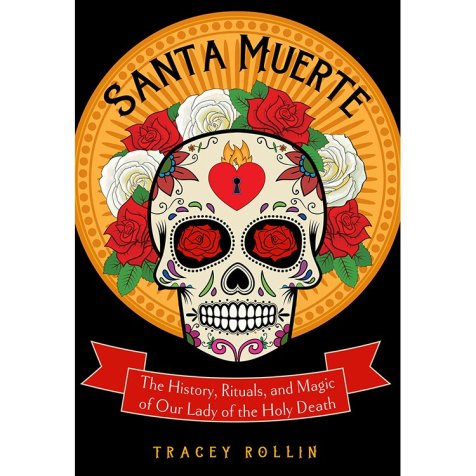
Santa Muerte by Tracey Rollin

Santa Muerte: The History, Rituals, and Magic of Our Lady of the Holy Death
Tracey Rollin
Weiser, 2017

wp36 santa muerte review

Review by Holli Emore

A saint for criminals? A goddess who accepts everyone? A holdover from the blood cult of the Aztecs? It seems that everyone from the New York Times to Reza Aslan (Believer 2017 television series) to the Roman Catholic Church are either intrigued, enchanted or upset about Nuestra Señora de la Santa Muerte, or Santa Muerte for short. Our Lady of Holy Death, the skeleton in a colorful dress, is rapidly acquiring new followers throughout Mexico and the southeastern United States. The Bony Lady, as some call her, is either a folk saint unauthorized by the church, or a goddess, depending on who you talk to. Either way, she is beloved and revered, particularly for her power to answer the prayers of her devoteés.

Tracey Rollin has written what might be the definitive Pagan book about Santa Muerte, skillfully weaving the bright colors of personal experience, history and lore, and suggested modern practice. Santa Muerte: The History, Rituals, and Magic of Our Lady of the Holy Death is beautifully-written. Rollin begins with an account of her Catholic childhood then goes on to provide fascinating details about the presumed origins of Santa Muerte, who is arguably based on the Aztec goddess Mictecacihuatl (also connected with the goddess Tonantein, who many believe to be the source of Our Lady of Guadalupe.) The church already had several patron saints of the dead, but Rollin notes that Santa Muerte is a haven of last resort for the marginalized such as prostitutes, addicts and, yes, drug cartel members.

This is the dark underside of Santa Muerte devotion which leads law enforcement to dread cartel followers who they feel act with more abandon and violence, thinking that they are under a special protection by the saint-goddess. It is even murmured that some will kill as an offering to Santa Muerte. Rollin does not apologize for this unfortunate connection, but relates it as being a natural outgrowth of Santa Muerte’s universal acceptance of all who come to her for protection and favors. In that aspect, she closely resembles many mother goddesses associated with death such as Kali, Hela, Oye or Sekhmet, or even the earth itself, which both gives and reclaims life with apparent disregard of status or even goodness. Neither death nor Santa Muerte discriminate; they come for each of us eventually.

If you are up to the challenge of looking into the compassionate but unyielding face of death, Santa Muerte (the book) may be your best introduction to a relationship with the saint-goddess. You will read about color aspects, using candles and novenas, rosary, incense, oil– even chocolate offerings. Rollin shares a number of prayers, blessings and other liturgical elements, even a banishing ritual à la the Lesser Banishing Ritual of the Pentagram. While ending with a helpful glossary and a recommended reading list, a glaring omission from this otherwise excellent volume is the complete lack of references. Perhaps a future edition will add citations to satisfy those of us with inquiring minds.

Want to buy this book?

Njord and Skadi by Sheena McGrath

Njord and Skadi: A Myth Explored
Sheena McGrath
Avalonia, 2016

wp36 Njord and Skadi review mcGrath wp36

Review by Erin Lale

Njord and Skadi is a good overview of the source material and the opinions of major scholars about these gods and their context. It also mentions some works of popular culture on the subject. The book is easy to read, and suitable for both general and academic readers.

The book has a lovely cover by Laura Daligan featuring the two title gods in a design reminiscent of a Yin and Yang sign, surrounded by a repeating Elder Futhark rune row with the variant Ingwaz and with the Dagaz and Othala in the variant reverse order.

The book starts off with a summary of the plot of the myth of Njord and Skadi’s marriage, including the prequel about Skadi’s father Thiazzi, which McGrath considers an essential part of the story. It goes into historical detail about the poem by which the myth was transmitted to us, and then quotes the poem, (in English translation) in its entirety, with explanations of the meanings of the kennings.

McGrath draws parallels between the plot of the poem and the story of Hrungnir. Then the author discusses the authenticity, dating, and interpretation of the myth of Njord and Skadi. McGrath goes into the question of whether Njord is Nerthus, examining evidence and various scholars’ opinions. She covers the origin and meaning of the name Skadi and Scandinavia. She writes about the other gods who appear in the two linked stories of Skadi and of her father.

The book strays into etymology, examines the theme of cooking in the story of Thiazzi and Idunna, and relates that to the apple motif in various Indo-European cultures. It also gives background information on the peoples and places in heathen mythology. Then McGrath tells about various interpretations of the meaning of this myth.

McGrath details the many words for giant and their connotations.This discussion relates to who Skadi is, since her father Thiazzi is a giant. A discussion of places named after Skadi follows, as well as description of historical worship of her. The author details historical evidence for giantess worship and proceeds to describe the nature of gods and giants, as well as the primal schism between them.

McGrath then presents the idea that Skadi represented a Saami woman. Skadi hunts on skis with a bow, like Saami women did. In the final few chapters, McGrath mops up some remaining questions, such as, “what is a hostage?”, and “how does that relate to Njord’s position in Asgard?”

This book strikes a good balance between providing detail for an academic reader and keeping a general reader from getting lost. The author presents a comprehensive roundup of the scholarship on the subject of this story. Recommended for pagan readers, especially for heathens and polytheists interested in Skadi, Njord, or giantesses.

Want to buy this book?

Brigid by Morgan Daimler

Pagan Portals: Brigid
Morgan Daimler
Moon Books, 2015

wp36 brigid daimler review

Review by Hugh Eckert.

The pan-Celtic Goddess Brigid is my Patroness, so naturally I’m interested in books about Her. All too often, I find that there’s a tendency to reduce Her to a facet of the Wiccan “Great Goddess” or the “Divine Feminine” of Goddess spirituality. There’s also considerable confusion between the Goddess Brigid, and the Christian saint that bears the same name. I’m a polytheist Pagan, and for me Brigid is an individual, discrete Goddess (or set of Goddesses; a matter which Daimler addresses in her book).

With all that, I was excited to read what Morgan Daimler had to say about Brigid. Daimler is an Irish reconstructionist Pagan with a strong grounding in scholarship and an interest in presenting a balance between research and personal religious experience. This is a living faith to her, and I get the impression that her research is part of her devotion.

Daimler’s book provides a concise and immensely readable introduction to the Goddess Brigid. The book starts with an introduction to the Goddess (“Meeting Brigid”), followed by chapters on Her aspects and names outside of Ireland; Her mythology; symbols, animals and holidays pertaining to her; more modern myths, stories and practices tied to Her, and prayers, charms and chants for Her. Throughout the book, Daimler gives stories of her own experiences with Brigid and how this Goddess has affected her.

The book also has a guide to pronunciation, a list of mixed media resources, and an extensive bibliography. All in all, this is a wonderful work that balances lore with living practice. It’s subtitled “Meeting the Celtic Goddess of Poetry, Forge, and Healing Well”, and it’s just that: a valuable introduction and guide to devotion to the Goddess who holds my heart. Hail Brigid!

Want to buy this book?

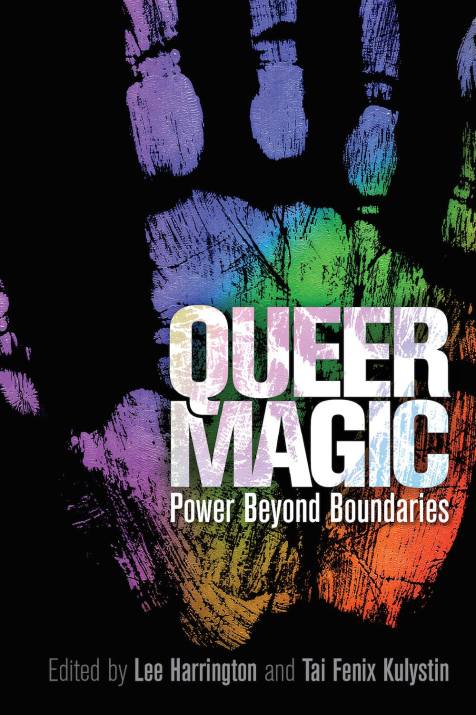
Queer Magic by Lee Harrington and Tai Fenix Kulystin

Queer Magic: Power Beyond Boundaries
Edited by Lee Harrington and Tai Fenix Kulystin
Mystic Productions Press, 2018

wp36 queer magic review

Review by Anthony Rella.

While the term “queer” has veered closer to being mainstream, it continues to retain the layers of trauma, danger, and transgressive excitement layered into its historical uses. What is “queer” is that which could not fit into the norms prescribed to us, and thus needed to find its own space to grow on the edges, in the cracks and corners. Queerness exists for itself, and it is medicine that heals and brings wholeness.

Thus queerness is elusive, evolving, and pluralistic. So, too, is this collection of pieces gathered together by editors Lee Harrington and Tai Fenix Kulystin. They have accomplished an impressive feat, publishing the voices and images produced by a wildly diverse and fascinating array of individuals.

One significant theme threaded throughout these works is the queer magical power of embodiment. In the essay “Living with Attunement with Sensation Rather than Identity,” Z Griss offers a queer praxis in which the sensory body leads in anchoring and producing the self in all its emerging complexity. Rather than encasing our experiences in labels and identity scripts, Griss shows a productive arc in which the body teaches and reveals mysteries of the self. Yin Q’s “Blood, Body, Birth, and Emptiness: Queer Magic in my Life and Work” articulates power and possibility within stigmatized experiences around cutting and BDSM, transforming her experiences of cutting into “rituals that affirmed life, whereas in prior years, [she] had focused on the thrill of annihilation.” In “The Endlessly Unfolding Mirror: An Introduction to the Queer Sex Magic of Traditional Witchcraft,” Troll Huldren offers body acceptance and eroticizing the Abject as a path to magical power.

Another queer theme emerges as the multiplicity of identity and porousness of self. M.C. MoHagani Magnetek’s “thaMind-Sol Lady’s Revenge” tells of an experience of duality between the speaker and an alter-ego, in which both strive to seek effective strategies to maintain dignity in the face of transphobia. The Reverend Teri D. Ciacchi articulates an experience of self as multiplicity, using the pronoun “we” “to express my internal experience of being an individual embedded in an ecological web of relatedness.” Ade Kola and Aaron Oberon in their respective essays explore the fluidity and multiplicity of identity through experiences of ritual possession, articulating ways in which deity contact becomes an unexpected site of queer transformations.

In an anthology of so many gifts, one of the highlights are the interviews of wolfie, who brings in the perspectives of First Nations queer elders Clyde Hall and Blackberri. wolfie’s “Chapter 23: The Plague Years” speaks to their own history and experience of living through the height of the AIDS epidemic. Kulystin and Harrington dedicate this anthology “to our queer ancestors and magical forebears,” and reverence for those who came before permeates the work, particularly in pieces such as Pavini Moray’s “The Glitterheart Path of Connecting with Transcestors.”

Want to buy this book?

Ask Baba Yaga by Taisia Kitaiskaia

Ask Baba Yaga: Otherworldly Advice for Everyday Troubles
Taisia Kitaiskaia
Andrews McMeel, 2017

wp36 ask baba yaga review

Review by Katessa S. Harkey.

Author Taisia Kitaiskaia traces her connection with the spirit of this gnarled fairytale witch to her childhood on the borderlands of a deep Russian woodland. Kitaiskaia served as mediator to the voice of Baba Yaga to querents on the website The Hairpin. This is a “best of” collection of these inquiries and the channeled responses received by the author.

The style is poetic, yet chthonic and earthy, as befits such a wild entity. The questions reveal an unusual depth of vulnerability, which strengthens the emotional investment for readers. While the poetry can be somewhat cryptic at times, seldom does one expect an old witch to give a straight answer; and thus the twisty answers only add to the mystique.

In example, to the question “How do I feel my feelings?” we get:

“Your feelings look to you like bison in the distance — stormy, powerful, & ready to charge. But feelings are not anything solid, to be killed or butchered and carried home. Walk toward yr bison; when you reach them, you will walk through them, as they aren’t bison at all, but clouds. You will feel the hue & mist of them, & then you will be on the other side.” (p. 69)

Presuming that the issue of this question that the querent is afraid to fully embrace their feelings, carrying through the visualization exercise contained in the response would act, in effect, as a powerful palliative spell. Anyone in the same boat has recourse to it by simply allowing the poetry to do its work upon the imaginal faculties.

This diminutive volume can be read in an afternoon, but it is better savored, as one would a fine wine, over many days. The book is peppered throughout with bold, tricolor artwork and design elements (black, white, and red) in traditional Russian motifs. Ask Baba Yaga is a rare opportunity to explore the traditional Russian mindset and worldview in very practical modern application.

There are other uses for the work besides as a “straight through” reader. An index of “summary questions” allows for searching topically for reference to one’s own life issues. Of course such matters are purely personal, but I have tested the work on three natural occasions for its use as a bibliomancy tool. I felt I got a “hit” two out of the three occasions. It would also be an ideal study for anyone preparing to embody Baba Yaga in ritual.

Finally, the greatest treasure of the work is the potent echo of the archetypal Crone Goddess’s voice. So much of our view of the Goddess is restricted to the beautiful Ladies of love and youth and even homely motherhood. Age has faced the world and no longer fears its phantasms.

To the question, “What’s the point?” Baba Yaga replies:

“Plow-horses carry out the duty given to them by some Master. For some-such reason, you have decided there is some other being —some Master — telling you what is to be done. & if so valiant, on whose behalf have you gone crusading?” (p. 105.)

On whose behalf, indeed, dear reader?

Want to buy this book?

Gwyn Ap Nudd by Danu Forest

Pagan Portals: Gwyn Ap Nudd — Wild God of Faerie, Guardian of Annwn
Danu Forest
Moon Books, 2017

wp36 gwyn ap nudd review

Review by Anthony Rella.

A contribution to Moon Books’ Pagan Portals series, Danu Forest’s Gwyn Ap Nudd is a slender book that provides an accessible and welcoming path to Celtic mythology, Welsh divinities, and a nature-centered practice. At only 94 pages, one still has the foundational material to begin a rich journey into nature worship, connection to the Fae, and devotional practice with this powerful god of the old Britons.

Through each section, Forest provides overviews and discussion of various myths associated with Gwyn Ap Nudd — as guardian of the underworld, as king of the fae, as leader of the Wild Hunt, and as one who lives in the glass castle of Glastonbury Tor. With each facet of this complex and intriguing figure, Forest offers suggestive insights into how a modern-day connection with wildness, the forest, and the dark spaces provides a rich and revivifying journey of transformation.

Forest also provides guided pathworkings to help practitioners make contact with and build their own connections to the figures described therein. Along with these pathworkings, she utilizes prayers and images from Celtic tradition to offer readers foundational tools for space clearing, purification, and personal initiatory experiences with the gods. Along with herthoughtful and researched discussions of the material, Forest offers suggestive hints or questions that could lead the curious practitioner into their own explorations of practice and research to root more deeply into the mythology.

For those interested in Celtic history and practice, this book would serve as an excellent addition to one’s research shelf. For those who are brand new to the tradition or — like myself — struggle to fully understand the mythology and its language, this book provides a gentle introduction that helps one to begin to understand the core concepts that arise so often in these practices.

Want to buy this book?

Dancing with Nemetona by Joanna van der Hoeven

Dancing with Nemetona: A Druid’s Exploration of Sanctuary and Sacred Space
Joanna van der Hoeven
Moon Books, 2014
sw087_nonfiction_Lawrence-Jennifer_Dancing-with-Nemetona_A-Druid's-Exploration-of-Sanctuary-and-Sacred-Space
Review by Jennifer Lawrence.

When I first began reading this book, I was wholly unfamiliar with the goddess Nemetona. I knew the word nemeton, of course; as a member of several druid organizations, it would be difficult to remain unaware of the idea of a sacred grove. As it turns out, it isn’t odd that I was unfamiliar with Nemetona, because very little is known of her with any sort of historical accuracy. A few place-names, a few inscriptions: all that’s left to tell us about a goddess whose worship apparently once stretched from Germany to Spain to Britain. Greece, Gaul, Ireland, Wales; these places paid reverence to her, but today she has all but vanished from history, and the author tells what little is known of her within a page and a half of introduction.

The first chapter talks about one’s personal “nemeton,” which, rather than being a term for the sacred space outside of one’s body, appears to be the author’s way of discussing a person’s aura — that veil of energy which wraps around and through the physical body, changes color and shape with health and mood, and can be impinged upon by others both positively and negatively.

As the book moves into further chapters, it takes time exploring Nemetona’s titles and purviews: the Lady of Edges and Boundaries, of Hearth and Home, of the Sacred Grove, of Sanctuary, of Ritual, and finally, of Everything and Nothing. Of all these, only the final chapter seems to be a stretch: while the last title might be valid in a modern interpretation of Nemetona’s strengths (which, of course, this is), I suspect that the original peoples that venerated the goddess might have found room to argue the point. If nothing else, “everything and nothing” smacks of a monotheistic deity that rules all, and given how many modern Pagans came to Paganism after leaving such monotheistic religions, they might not want much to do with a deity that claims some of the same qualities as the god they left behind. However, the rest of the material leading up to that chapter is excellent, both well-written and well-presented, although I might have wished that the book as a whole was longer.

It was a bit of a surprise to see how much of the material in this book was originally found by the author within the ideology of Zen Buddhism. This is less odd in today’s mix-and-match Paganism than one might suspect. The Zen material woven into the book actually supports the ideas on Nemetona well enough to not be objectionable.

There is so much good material that works well in this book that the above-mentioned issues are of very small import. Not only are the exercises simple to do and effective, the greatest mass of the written material reads like poetry, full of elegant and beautiful imagery that flows like clean water. When the author describes the shadowed, quiet peace of the forest, the sweet smell of earth after the rain, the songs of the trees and the sunshine, the reader is vividly and instantly able to see that forest, smell the wet earth, and hear those songs. That ability to paint a vivid picture is one of the marks of a really talented writer. This is especially so in any book on material of a spiritual nature, where the reader must be lifted — or even torn — away from the dull reality of mundane life. That Van Der Hoeven has succeeded so well at this minimizes anything I might find fault with otherwise.

This was a beautifully-done book with some excellent exercises and enough material to give an individual the tools to begin a relationship with this obscure but important goddess and the things she rules over.

Want to buy this book?

Journey to the Dark Goddess by Jane Meredith

Journey to the Dark Goddess: How to Return to Your Soul
Jane Meredith
Moon Books, 2012

sw087_nonfiction_Eyers-Pegi_Journey-to-the-Dark-Goddess_How-To-Return-To-Your-Soul

Review by Pegi Eyers.

She is the one who makes and unmakes us. She is the one resting deep inside us when we think we have nothing left.” — Jane Meredith

The Dark Goddess as we know her is Kali the Destroyer, Hecate the Nightwalker, Morgana the Villainess, the Wicked Stepmother, Persephone Descending, and the Crone. She is also the necessary shadow side of life, the terrifying or womb-like darkness we all encounter. Sudden change, illness, accidents, grieving or sea changes of the soul — all these things can bring us face-to-face with the terrain of the Dark Goddess. Meet Her we must, but as Jane Meredith tells us, better to get to know Her ahead of time, and become familiar with the intricacies of change, healing and renewal. Journey to the Dark Goddess is a wise and wonderful guidebook for our journey into the transformational darkness and back again.

Using powerful symbols in the myths of Persephone, Inanna and Psyche, Jane traces the many stages of our visit to the Underworld, offering stories, rituals and guideposts to prepare for our Descent, our time in the Underworld, coming back, and continuing the cycle of life.

The myths and fairy tales of heroines who have lost everything, who are stripped to the bone and still come back reborn, have deep fascination and meaning for us. Similar to the many personal narratives found in the book, during my own experience with serious illness, I spent many months firmly in Her dark embrace. Feeling safe and protected at all times, I arose from the ashes and gained powerful life lessons. The Dark Mother grabbed me, held me, loved me and let me go. I learned that once you surrender and embrace Her in her full glory, powerful insights are waiting to be found.

Meredith is a superb guide to uncovering the meaning and metaphor in ancient mythologies as maps that we can apply to our lives today, and she fully grounds us in the self-inquiry and soul-expression tools such as journaling, dreaming, dancing, creating mandalas, altars, art and poetry. She offers powerful and meaningful rituals that connect us to Diety and the Earth, bringing clarity and integration to our own unique journey.

Instead of resisting, or being dragged kicking and screaming, Jane suggests that we deliberately seek out the means and methods to face the Dark Goddess. As much as the dominant society denies it, the fertility and blessings of the darkness are a natural part of nature’s cycles, such as the waxing and waning of the moon and the growth and passing away of the seasons. “Living eternally in the dark is no more a natural existence than staying eternally in the light.” Jane urges us to taste the pomegranate, open Pandora’s box and willingly step into the unknown to bring much-needed balance to our lives and the Earth.

Want to buy this book?

Merlin Stone Remembered by David H. Axelrod, Carol F. Thomas, and Lenny Schneir

Merlin Stone Remembered: Her Life and Works
David H. Axelrod, Carol F. Thomas and Lenny Schneir
Llewellyn Publications, 2014

sw087_nonfiction_Ardinger-Barbara_Merlin-Stone-Remembered

Review by Barbara Ardinger.

Merlin Stone’s book, When God Was a Woman, was a lightning bolt of feminist scholarship that told the world that before there was a Judeo-Christian god there were goddesses, and before there were goddesses, there was the Goddess. If you’re reading this review and you have not read When God Was a Woman, buy the book. Right now. As you sink into Stone’s book, try to imagine what it was like before we knew about Isis or Inanna or Astarte, before we knew that the tree in the Garden of Eden was probably a sacred fig and that the serpent was a symbol or aspect of the Goddess and that people who ate figs or worked with serpents were honored priestesses and prophets. The work of the second wave feminists added to the work of scholars like Merlin Stone and Marija Gimbutas, but this didn’t begin until the second half of the 20th century. Before that? Just “God the Father, maker of heaven and earth.”

Gloria Orenstein puts Stone’s work in context. Orenstein cites G. Rachel Levy’s The Gate of Horn (1948), Helen Diner’s Mothers and Amazons (1973), and Elizabeth Gould Davis’ The First Sex (1971). These books gave us some of our foundational myths, but, Orenstein writes, “we can see that although there was some writing that had already attempted to reconstruct a history of women …, much more expertise and authority were needed” (p. 8).

She continues, “Once Merlin Stone provided us with her careful scholarship and a truly feminist (not biased, patriarchal) accounting of ancient Goddess cultures, I and all who found Merlin’s work were finally able to understand our herstory…” (p. 9).

Merlin Stone Remembered is divided into eighteen parts; one is a timeline. Stone was born as Marilyn Jacobsen in 1931, became a sculptor and teacher, and in 1972-73 traveled in the Middle East to do research. She met her life partner Lenny Schneir in 1976, was featured in Donna Reed’s film The Goddess Remembered in 1989, and died in 2011.

Another part is Schneir’s memoir, a panegyric in which he describes himself when they met as a wannabe “manly man.” Though they never married, he and Stone lived together for thirty-four years. She turned his life around. “I worshipped her,” he writes. “She … sculpted me into everything I wanted to be. I needed her energy to succeed, and she gave it to me generously, naturally, and fully” (p. 74). He describes a homey, hippie life. It’s a fascinating read.

Unraveling the Myth of Adam and Eve” is Chapter 10 from When God Was a Woman. Rereading this chapter, we see again the depth of Stone’s work. Citing the best known male scholars of the 20th century, she also tells us about evidence of Goddess cultures — not cults! —found by those scholars and others in sites around the Mediterranean.

Regarding Stone’s second book, Ancient Mirrors of Womanhood, which is descriptions of goddesses, stories about them, and liturgical free verse, editor Axelrod writes that Stone’s poetry “teaches, coaches, and sings the long-lost, the banished, the often-forbidden goddesses back into our lives” (p. 141).

There’s more in the book, including Stone’s notes for a presentation in which she carries on a conversation with the voice, named Intuition, in her head. Unpublished works, including parts of a novel, poetry, color photos, a long section on Stone as an artist and sculpture, a remembrance written by one of her daughters. You may be long familiar with Stone’s work or this may be your introduction to it; either way, this is a valuable resource. Highly recommended.

P.S. A personal note. The book was lying on my couch when a friend who is an astrologer and Tarotist came to visit. She saw it, exclaimed, picked it up, and said. “I read When God Was a Woman in 1988 or 89 and it changed my life.” Me, too.

Want to buy this book?

Newer entries »

Design a site like this with WordPress.com
Get started